Case Study · 2026
RAG Document Assistant — Retrieval-Augmented Chat
Building a retrieval-augmented chat assistant — chunking documents, embedding them into a vector store, and answering questions grounded in real content instead of guesses.
Context
A retrieval-augmented generation, or RAG, assistant that answers questions grounded in a set of source documents, rather than relying purely on a language model's memory. Documents are chunked, embedded, and stored in a vector database, then retrieved and passed to an LLM at query time.
The Problem
Language models alone can hallucinate or lack knowledge of specific documents. The goal was to build a pipeline that grounds every answer in actual retrieved content, so responses stay accurate and traceable to a source.
Process
Chunking and ingestion
Source documents are split into smaller chunks during onboarding, so they can be embedded and indexed at a granularity that keeps retrieval accurate and relevant.
Embedding and vector storage
Each chunk is converted into an embedding and stored in a Chroma vector database, enabling fast similarity search against a user's query.
Retrieval and generation with Gemini
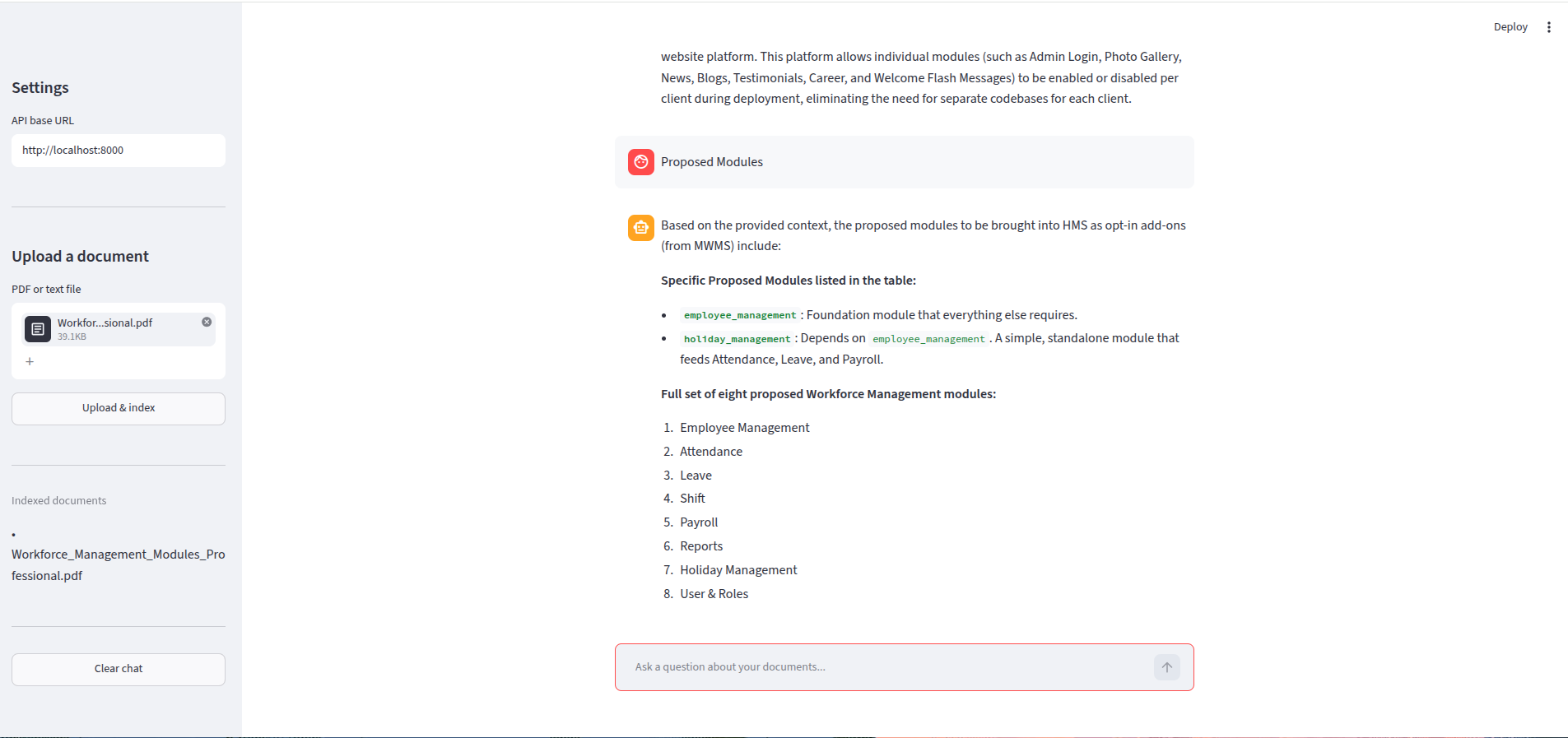
At query time, the most relevant chunks are retrieved from Chroma and passed as context to the Gemini API, which generates a grounded, context-aware answer.
Interface with Streamlit
Built a simple, interactive front end using Streamlit, letting users upload documents and chat with the assistant directly in the browser.
Design Decisions
Chunk-based ingestion over whole-document embedding
Breaking documents into chunks keeps each embedded unit focused, improving retrieval precision compared to embedding entire documents at once.
Chroma as the vector store
A lightweight, easy-to-integrate vector database suited to a project of this scale, without the overhead of a hosted vector service.
Gemini for generation
Used Gemini's API to handle the final answer generation step, combining retrieved context with the user's question into a coherent response.
Outcome
✦ End-to-end RAG pipeline from document upload to grounded answer generation
✦ Chunking and embedding pipeline feeding a Chroma vector database
✦ Interactive Streamlit interface for real-time question answering
Personal/academic project — full flow and screens available on request.
Reflection
“The core lesson was that retrieval quality drives generation quality — getting the chunking and embedding step right mattered more than the choice of language model itself.”